Dealer Uptime Services
Designing, measuring and reporting a pilot that turned Ford dealers into uptime partners for small fleets, from journey maps and service blueprint to the dashboard that tracked it through to market launch.
- Role
- CX lead: journeys and blueprint, measurement framework, data pipeline and dashboard
- Team
- European CX, dealer enablement, UX and digital, go-to-market, product and pilot teams
- Context
- Ford Pro
- Year
- 2025–26
Outcome
My Power BI dashboards became the pilot's central reporting tool and stayed in use through to the market launch of Dealer Uptime Services. They replaced a weekly manual spreadsheet process with one source of truth across ten data sources.
- dealer sites onboarded
- 15
- fleet customers
- 550
- vans sharing health data
- 2,284
- dealer staff trained
- 89
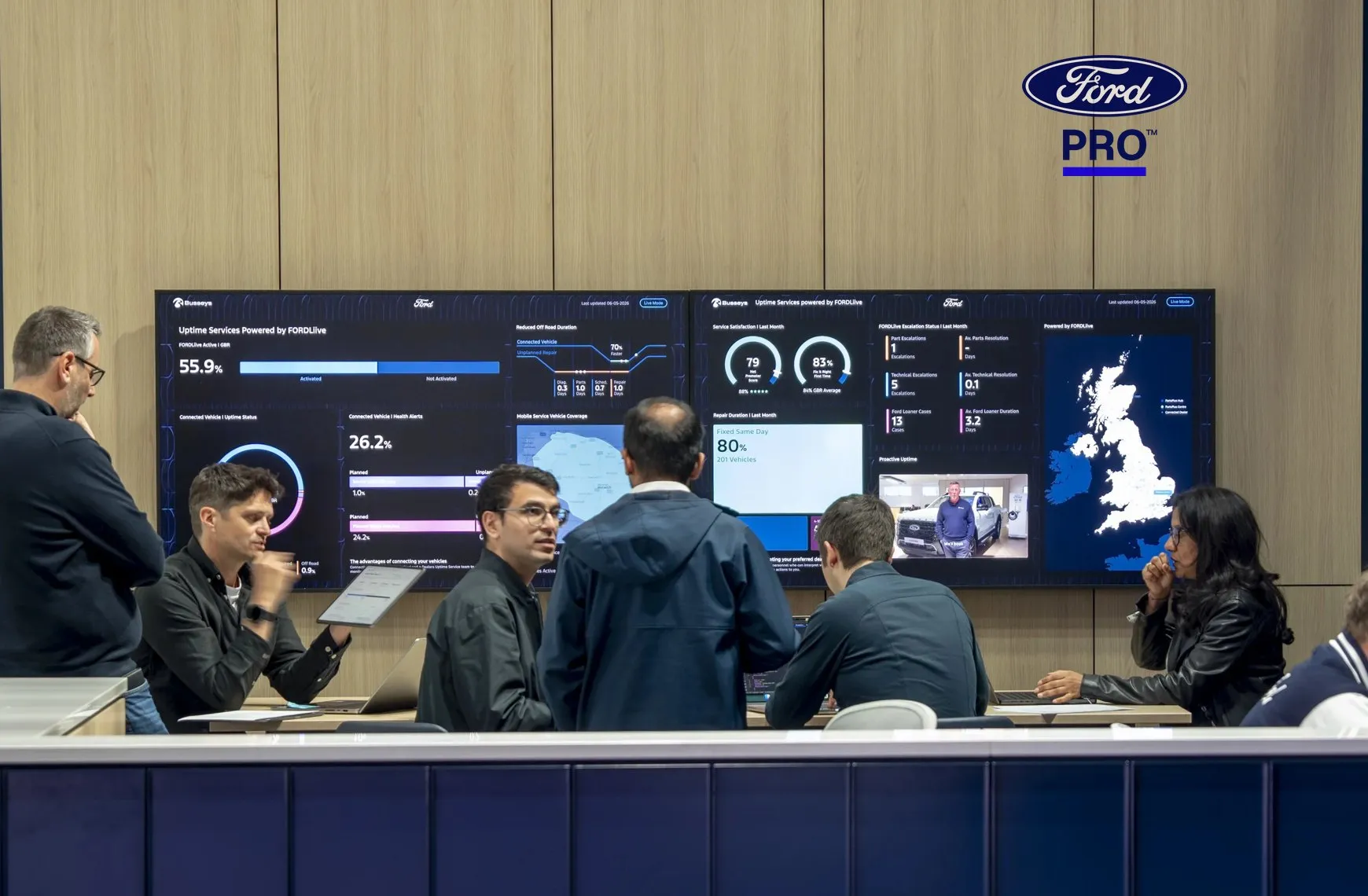
A van off the road costs a small business around €700 a day. Ford Pro already receives millions of health signals a day from more than 1.2 million connected vans in Europe, but a small fleet with a handful of vans was never going to watch a telematics dashboard. Their local dealer could.
Dealer Uptime Services (DUS) piloted exactly that. Dealers used Ford’s Vehicle Care Portal to see prioritised health alerts for their customers’ vans, then called to book the fix before it became a breakdown. The pilot had to prove that this data lets dealers sell an uptime service that makes them more per customer and costs customers less.
My part: I mapped the customer and dealer journeys with the European CX and dealer enablement teams, built the service blueprint with the UX and digital team, wrote the dealer pitch guidance, interviewed pilot dealers on site, designed how the pilot would be measured, then built the data pipeline and dashboard that tracked it, solo, until I handed it over in March 2026. Those dashboards went on to be the central reporting tool for the pilot’s scale-up and the service’s market launch.
Mapping the service
The service only works if three groups change how they work at once: fleet customers, dealer staff and Ford’s own teams. We started from how small fleets buy and service vans today, then designed how the pilot needed to run, front stage and back.
I mapped the current and future journeys in collaboration with the European CX team and dealer enablement, and built the service blueprint with the UX and digital team. I then ran the workshops that reconciled the two across UX, go-to-market, product and the pilot team. Finally, I extended both maps with the lanes I needed for measurement: the metric that would show whether each stage was working, and the data source it would come from.
From today's journeys to the pilot blueprint
Four maps. Pick a stage to see what happens in it, or open the full map.
How small fleets buy a commercial vehicle today, built from dealer site visits and customer panels in the UK and Germany.
01Trigger and research
Customer actions
- New business, a renewal cycle, changing needs or a van beyond repair starts the search
- Researches online and asks other business owners
Dealer actions
- Monitors online leads and third-party ads
- Uses existing contacts to prospect
Touchpoints
Ford and dealer websites, third-party lead sites, CRM
Insights
Over half of commercial vehicle sales happen by phone or email
Pain points
- Website is fragmented and information is hard to find
Where the uptime service could fit
- 1 Promotion on the dealer website
02Consider
Customer actions
- Calls, emails or visits the dealer to discuss requirements
- Asks whether an EV or a conversion would work
- Sometimes test drives, mostly for new technology
Dealer actions
- Qualifies the customer, checks stock
- Discusses options, trade-in, conversions and finance
Touchpoints
Showroom, phone, email, configurator
Insights
Showroom sales are quick, price-led and product-focused
Pain points
- Dealer can't answer questions about Ford Pro services or EVs
- Staff haven't been trained on Ford Pro and lack confidence demoing telematics
Where the uptime service could fit
- 2 Sales exec raises it at replacement time
- 3 Pitched at the first consultation
03Purchase
Customer actions
- Negotiates finance and trade-in
- Confirms spec and options, then places the order
Dealer actions
- Creates quotes, orders and finance documents
- Pitches add-ons like warranties
- Refers the customer to Ford Pro to activate software
Touchpoints
Ordering and finance systems, e-signature
Insights
What dealers sell tracks closely with how they are paid
Pain points
- Dealer can only refer customers to Ford Pro, not sell
- No visibility of what happens after a referral
Where the uptime service could fit
- 4 Offered as an add-on during spec
- 5 Enrolment at marketing-consent capture
- 7 At referral to Ford Pro software
04Wait for delivery
Customer actions
- Waits for updates on build and delivery
- Agrees a handover date
Dealer actions
- Chases build updates and keeps the customer informed
Touchpoints
Dealer portal, phone, email, WhatsApp
Insights
Customers want to know what to expect and when
Pain points
- Delivery dates come from too many sources and change
05Handover and ownership
Customer actions
- Collects the van and sets up the app
- Gets check-in calls and several surveys
Dealer actions
- Runs the vehicle check and handover
- Connects the van to the app
- Calls for feedback on ownership
Touchpoints
Ford app, survey platforms
Insights
Customers don't distinguish the dealer from Ford, and expect anyone to know their history
Pain points
- Several people from Ford and the dealer contact the customer
- Too many surveys
Where the uptime service could fit
- 6 Pre-handover chat with the decision-maker
See the full map
Every lane, every stage. Scroll sideways.
- New business, a renewal cycle, changing needs or a van beyond repair starts the search
- Researches online and asks other business owners
- Calls, emails or visits the dealer to discuss requirements
- Asks whether an EV or a conversion would work
- Sometimes test drives, mostly for new technology
- Negotiates finance and trade-in
- Confirms spec and options, then places the order
- Waits for updates on build and delivery
- Agrees a handover date
- Collects the van and sets up the app
- Gets check-in calls and several surveys
- Monitors online leads and third-party ads
- Uses existing contacts to prospect
- Qualifies the customer, checks stock
- Discusses options, trade-in, conversions and finance
- Creates quotes, orders and finance documents
- Pitches add-ons like warranties
- Refers the customer to Ford Pro to activate software
- Chases build updates and keeps the customer informed
- Runs the vehicle check and handover
- Connects the van to the app
- Calls for feedback on ownership
- Website is fragmented and information is hard to find
- Dealer can't answer questions about Ford Pro services or EVs
- Staff haven't been trained on Ford Pro and lack confidence demoing telematics
- Dealer can only refer customers to Ford Pro, not sell
- No visibility of what happens after a referral
- Delivery dates come from too many sources and change
- Several people from Ford and the dealer contact the customer
- Too many surveys
- 1 Promotion on the dealer website
- 2 Sales exec raises it at replacement time
- 3 Pitched at the first consultation
- 4 Offered as an add-on during spec
- 5 Enrolment at marketing-consent capture
- 7 At referral to Ford Pro software
- 6 Pre-handover chat with the decision-maker
How planned servicing and unplanned repairs work today, from the first warning light to collecting the van.
01Trigger
Customer actions
- A service falls due, a warning light comes on or the van breaks down
- Calls roadside assistance if it can't be driven
Dealer actions
- Accepts or turns down a breakdown recovery depending on capacity
Touchpoints
Dashboard warning, roadside assistance
Insights
Drivers may ignore warning lights and not tell the fleet manager
Pain points
- Van turned away by the local dealer when the workshop is full
- Out-of-hours drop-offs left at unsecured sites
02Booking
Customer actions
- Calls the dealer or books online
- Repeats vehicle and personal details
Dealer actions
- Service advisor checks the customer record, service history and any vehicle health data
- Books the slot
Touchpoints
Phone, online booking, dealer management system
Insights
Customers who are comfortable online prefer digital booking
Pain points
- Online bookings aren't connected to the dealer system, so details are typed twice
03Preparation
Customer actions
- Gets a reminder call the day before
Dealer actions
- Pre-orders and stages parts two to three days ahead
- Prints the job card
Touchpoints
Parts system, job card
Insights
Dealers only pre-order parts if they can return unused ones without a fee
Pain points
- Automated reminders get missed
- Parts shortages hit both uptime and workshop capacity
Where the uptime service could fit
- 9 Reminder call before the appointment
04Arrival and check-in
Customer actions
- Finds parking and reception
- Confirms details and signs the job card
- Moves tools into a courtesy van, if one is offered
Dealer actions
- Records damage
- Offers express service, mobile service or a courtesy van
Touchpoints
Reception, paper or digital job card
Insights
Many dealers still prefer paper job cards
Pain points
- Hard to park
- Slow manual check-in
- Worry about expensive tools left in the van
05Workshop
Customer actions
- Gets a video health check and approves or rejects extra work
- Calls for progress if the repair runs long
Dealer actions
- Assigns a technician by job complexity
- Inspects, diagnoses and repairs
Touchpoints
Video health check, diagnostic tools
Insights
Customers push back on unexpected extra work
Pain points
- Not knowing the repair status or when the van will be back is worse than the breakdown itself
Where the uptime service could fit
- 8 Decision-maker consulted on extra work: pitch prevention, and data sharing if the modem isn't active
- 10 After the health check: how monitoring could have caught this earlier
06Collection and aftercare
Customer actions
- Reviews the work, pays and collects the van
- Receives a survey
Dealer actions
- Walks the customer through the work and invoices
- Follows up on outstanding issues
Touchpoints
Invoice, survey
Insights
Customers value courtesy vans and pick-up and delivery, which are expensive for dealers
Pain points
- Collection only during opening hours
- Moving tools between vans twice
Where the uptime service could fit
- 11 At handover after the service
- 12 Follow-up once the customer has had time to think
See the full map
Every lane, every stage. Scroll sideways.
- A service falls due, a warning light comes on or the van breaks down
- Calls roadside assistance if it can't be driven
- Calls the dealer or books online
- Repeats vehicle and personal details
- Gets a reminder call the day before
- Finds parking and reception
- Confirms details and signs the job card
- Moves tools into a courtesy van, if one is offered
- Gets a video health check and approves or rejects extra work
- Calls for progress if the repair runs long
- Reviews the work, pays and collects the van
- Receives a survey
- Accepts or turns down a breakdown recovery depending on capacity
- Service advisor checks the customer record, service history and any vehicle health data
- Books the slot
- Pre-orders and stages parts two to three days ahead
- Prints the job card
- Records damage
- Offers express service, mobile service or a courtesy van
- Assigns a technician by job complexity
- Inspects, diagnoses and repairs
- Walks the customer through the work and invoices
- Follows up on outstanding issues
- Van turned away by the local dealer when the workshop is full
- Out-of-hours drop-offs left at unsecured sites
- Online bookings aren't connected to the dealer system, so details are typed twice
- Automated reminders get missed
- Parts shortages hit both uptime and workshop capacity
- Hard to park
- Slow manual check-in
- Worry about expensive tools left in the van
- Not knowing the repair status or when the van will be back is worse than the breakdown itself
- Collection only during opening hours
- Moving tools between vans twice
- 9 Reminder call before the appointment
- 8 Decision-maker consulted on extra work: pitch prevention, and data sharing if the modem isn't active
- 10 After the health check: how monitoring could have caught this earlier
- 11 At handover after the service
- 12 Follow-up once the customer has had time to think
How the service needed to work for dealers and customers during the pilot. The bottom lane is what I added when designing measurement: the metric that showed whether each stage was working, and where it had reached by March 2026.
01Contracting
Dealer actions
- Joins a pitch from the pilot team
- Signs the pilot agreement
Touchpoints
Pitch meeting, agreement
What pilot dealers told us
Dealers want to feel confident about Ford Pro before selling it
Moments that matter
- Dealers expected a different tool from the one they got
How I measured it (by Mar 2026)
- Dealer sites onboarded: 15
02Training
Dealer actions
- Attends in-person training on the health portal and go-to-market plan
- Gets portal access
Touchpoints
Training session, health portal
What pilot dealers told us
Dealers asked for on-demand video training with case studies and role-play
Moments that matter
- Training has to cover selling, not just the software
How I measured it (by Mar 2026)
- Staff trained: 89
- Confidence, pre vs post: 2.9 → 4.6 out of 5
03Lead identification
Dealer actions
- Uses a qualification toolkit to find suitable customers
Touchpoints
Qualification toolkit, CRM
What pilot dealers told us
The service fits small fleets that use a single dealer
Moments that matter
- Pitching to someone who isn't the fleet decision-maker
How I measured it (by Mar 2026)
- Vans submitted for onboarding: 2,621
- Capability rate (capable ÷ submitted)
04Customer pitch
Customer actions
- Hears about the service while buying, servicing or replacing a van
- Raises concerns about cost and data sharing
Dealer actions
- Pitches at one of 12 moments across sales and service, from the website to vehicle handover
Touchpoints
Website, showroom, phone, service desk
What pilot dealers told us
Customers see the productivity benefit quickly, but not the cost saving
Moments that matter
- Dealers are used to closing sales, not explaining services
- Hard to show value over the phone
How I measured it (by Mar 2026)
- Customers onboarded: 550
- Average 3.6 vans per customer
05Contract and consent
Customer actions
- Shares the list of vans to check
- Signs an agreement naming the enrolled vans and consenting to data sharing
Dealer actions
- Prepares the contract and sends the van list to Ford for a capability check
- Tells the customer which vans qualify
Touchpoints
E-signature, email
What pilot dealers told us
Pilot dealers reported no customer objections to data sharing
Moments that matter
- Paperwork and consent spread across email and forms
How I measured it (by Mar 2026)
- Vans with data consent: 2,284
- Consented ÷ capable
06Account set-up
Customer actions
- Gets a welcome email setting out timings and support contacts
- Confirms consent and sets a password
Dealer actions
- Gets confirmation that the customer's vans are live in the portal
Touchpoints
Welcome email, Ford Pro account
What pilot dealers told us
Customers want to know how long set-up takes
Moments that matter
- No promised set-up time
- Customers miss the email and never activate
How I measured it (by Mar 2026)
- Vans subscribed: 1,982
- Cases resolved within 2 weeks: 79%
- Time stuck in 'pending'
07Daily use
Customer actions
- Nothing to do: vans are monitored in the background
Dealer actions
- Reviews prioritised health alerts
- Checks history, logs the next action and calls the customer
Touchpoints
Health portal, dealer management system
What pilot dealers told us
Non-technical aftersales staff could run the portal from day one
Moments that matter
- Customers have preferred times and channels for calls
How I measured it (by Mar 2026)
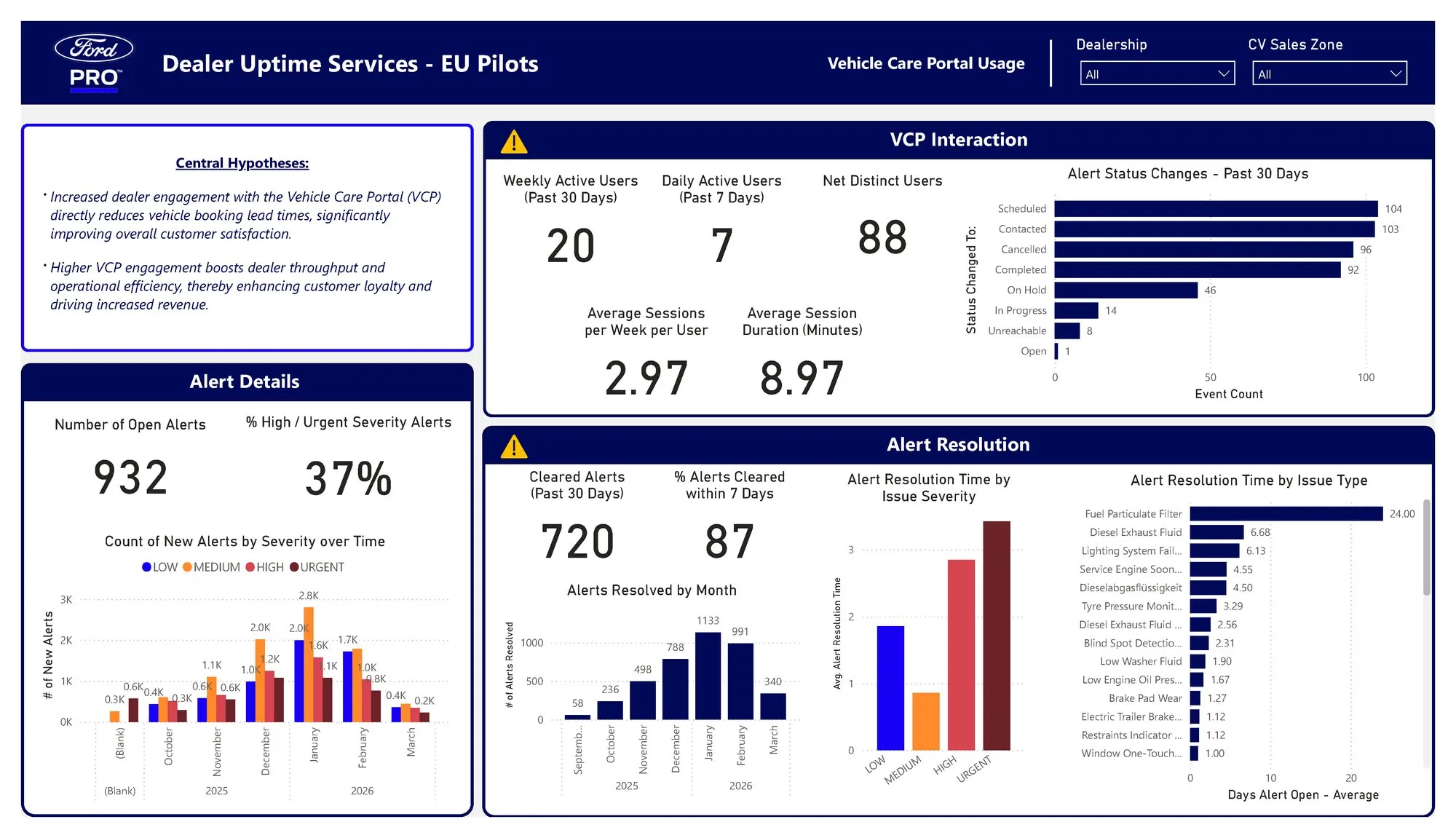
- Weekly active portal users: 20
- Alerts cleared within 7 days: 87%
08Vehicle serviced
Customer actions
- Gets a call about an issue and agrees a time
- Knows the cost up front
- Drops off and collects the van
Dealer actions
- Pre-orders parts and schedules the job
- Calls when the van is ready
Touchpoints
Phone, parts system, job card
What pilot dealers told us
Dealers booked new work in the first week
Moments that matter
- Customers can't easily get to the dealer during opening hours
How I measured it (by Mar 2026)
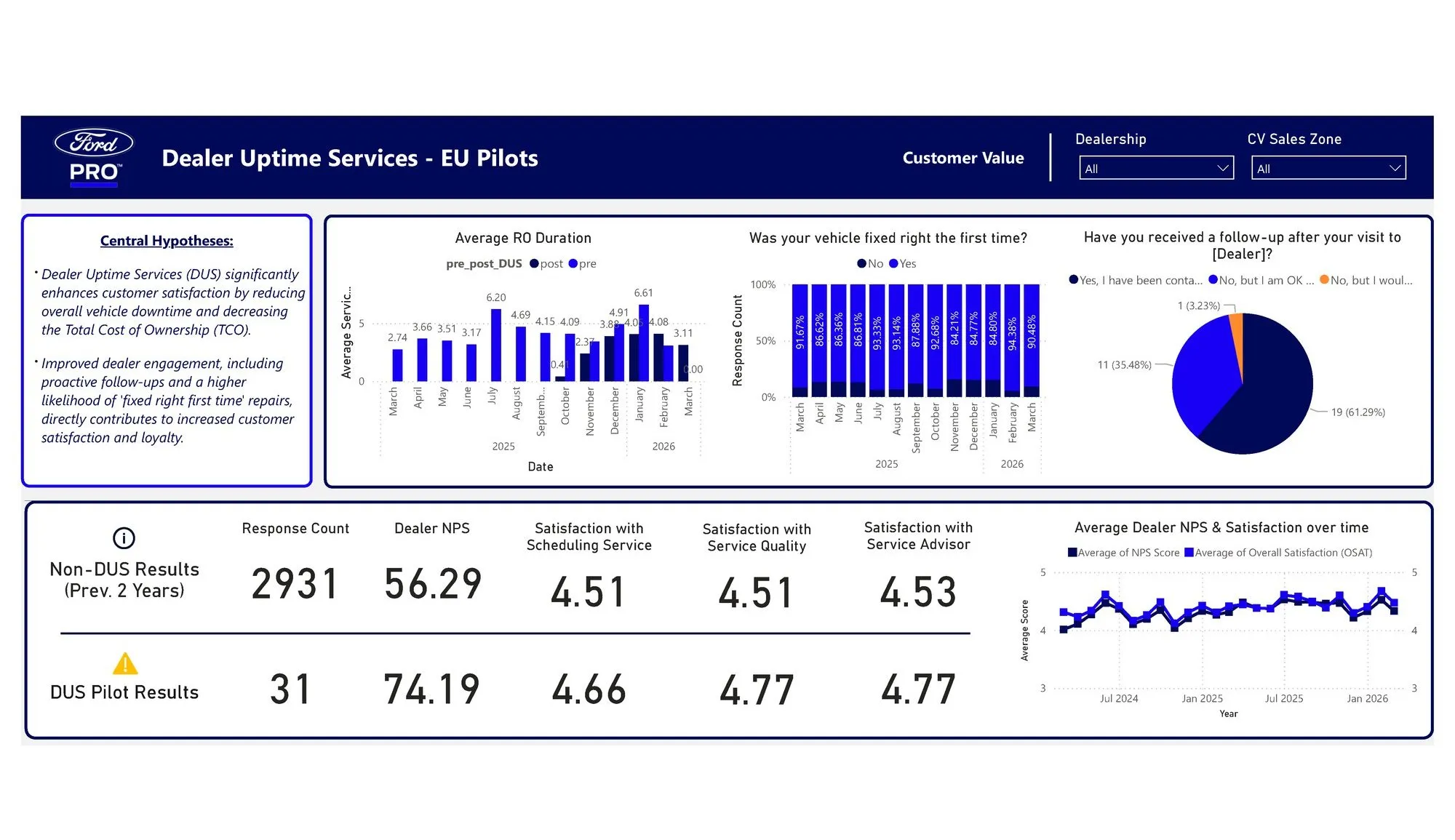
- Repair order duration: 6.26 → 3.62 days
- Fixed right first time: 87% → 97%
09Aftercare and offboarding
Customer actions
- Gets a follow-up call and a survey
- Can add or remove vans, or cancel
Dealer actions
- Follows up on outstanding issues and primes the survey
- Asks about adding vans
Touchpoints
Phone, email, survey
What pilot dealers told us
Recall alerts were welcomed; minor alerts like washer fluid felt patronising
Moments that matter
- No clear plan for what happens when the pilot ends
How I measured it (by Mar 2026)
- Dealer NPS: 56 → 74 (small sample)
- Vans defleeted: 11
See the full map
Every lane, every stage. Scroll sideways.
- Hears about the service while buying, servicing or replacing a van
- Raises concerns about cost and data sharing
- Shares the list of vans to check
- Signs an agreement naming the enrolled vans and consenting to data sharing
- Gets a welcome email setting out timings and support contacts
- Confirms consent and sets a password
- Nothing to do: vans are monitored in the background
- Gets a call about an issue and agrees a time
- Knows the cost up front
- Drops off and collects the van
- Gets a follow-up call and a survey
- Can add or remove vans, or cancel
- Joins a pitch from the pilot team
- Signs the pilot agreement
- Attends in-person training on the health portal and go-to-market plan
- Gets portal access
- Uses a qualification toolkit to find suitable customers
- Pitches at one of 12 moments across sales and service, from the website to vehicle handover
- Prepares the contract and sends the van list to Ford for a capability check
- Tells the customer which vans qualify
- Gets confirmation that the customer's vans are live in the portal
- Reviews prioritised health alerts
- Checks history, logs the next action and calls the customer
- Pre-orders parts and schedules the job
- Calls when the van is ready
- Follows up on outstanding issues and primes the survey
- Asks about adding vans
- Dealers expected a different tool from the one they got
- Training has to cover selling, not just the software
- Pitching to someone who isn't the fleet decision-maker
- Dealers are used to closing sales, not explaining services
- Hard to show value over the phone
- Paperwork and consent spread across email and forms
- No promised set-up time
- Customers miss the email and never activate
- Customers have preferred times and channels for calls
- Customers can't easily get to the dealer during opening hours
- No clear plan for what happens when the pilot ends
- Dealer sites onboarded: 15
- Staff trained: 89
- Confidence, pre vs post: 2.9 → 4.6 out of 5
- Vans submitted for onboarding: 2,621
- Capability rate (capable ÷ submitted)
- Customers onboarded: 550
- Average 3.6 vans per customer
- Vans with data consent: 2,284
- Consented ÷ capable
- Vans subscribed: 1,982
- Cases resolved within 2 weeks: 79%
- Time stuck in 'pending'
- Weekly active portal users: 20
- Alerts cleared within 7 days: 87%
- Repair order duration: 6.26 → 3.62 days
- Fixed right first time: 87% → 97%
- Dealer NPS: 56 → 74 (small sample)
- Vans defleeted: 11
Everything needed behind the scenes to deliver the pilot, from dealer onboarding to offboarding. The data lane is the build-out: where each stage left a trace I could report on.
01Dealer onboarding
Physical evidence
Pilot agreement, training materials
Dealer front stage
- Gets trained in person
- Agrees a go-to-market plan with the field team
Dealer back stage
- Defines its sales pitch for the service
Ford Pro teams
- Account team provisions the dealer, adds the licence and confirms portal access
- Billing sets up the monthly subscription
Systems
CRM, marketplace, health portal, billing
Data I reported from
- CRM: dealer licence start dates
- Training survey: confidence before and after
Risks
- Dealers expect a different tool from the one they'll use
- Ongoing training and support not yet planned
02Customer sale
Physical evidence
Sales pitch, customer agreement
Customer
- Discusses a purchase, renewal or fleet change with the dealer
- Agrees to enrol and picks which vans
Dealer front stage
- Demos the service and the cost and uptime savings
- Prepares consent naming the vans
Dealer back stage
- Shares the van list and consent with Ford
Ford Pro teams
- Enablement team runs the capability check on each van
Systems
Capability check tool
Data I reported from
- CRM onboarding cases: vans submitted vs capable
Risks
- Sales could take hours or days, which makes set-up hard to plan
- A dealer-led pitch varies from dealer to dealer
03Account creation
Physical evidence
Welcome and verification emails
Customer
- Gets a verification email and sets a password
- Logs in
Dealer front stage
- Reminds the customer to set a password if they haven't
Ford Pro teams
- Account team checks for an existing account or creates one
- Sends the verification email
Systems
CRM, Ford Pro account
Data I reported from
- Marketplace: customers and accounts
Risks
- No guaranteed turnaround from the enablement team
- No follow-up if the customer ignores the email
04Vehicle set-up
Physical evidence
Confirmation from the dealer
Customer
- Hears from the dealer that the vans are being monitored
Dealer front stage
- Tells the customer they're set up
Ford Pro teams
- Enablement team confirms ownership, enrols the vans and records consent
- Chases failures, escalating after two attempts
Systems
Marketplace, consent platform, health portal
Data I reported from
- Marketplace: subscriptions, enrolment status, consent
Risks
- Unclear delay between consent and data appearing in the portal
05Monitoring
Physical evidence
Phone call about a vehicle issue
Dealer front stage
- Calls the customer to explain the work needed and book it
Dealer back stage
- Reviews alerts daily, grouped by customer
- Checks history and whether the van has been seen elsewhere
- Logs the next action and assigns a caller
Ford Pro teams
- Tracks onboarding cases and portal usage
Systems
Health portal, parts system, dealer management system
Data I reported from
- Portal analytics: active users, sessions
- Alert back end: severity, time to clear
Risks
- Without tracking, nobody can see where customers drop off
06Service visit
Physical evidence
Job card, invoice
Customer
- Agrees a time, brings the van in and collects it
Dealer front stage
- Carries out the work and calls when it's complete
Dealer back stage
- Checks parts lead times and orders
- Schedules the job
Systems
Dealer management system, parts system
Data I reported from
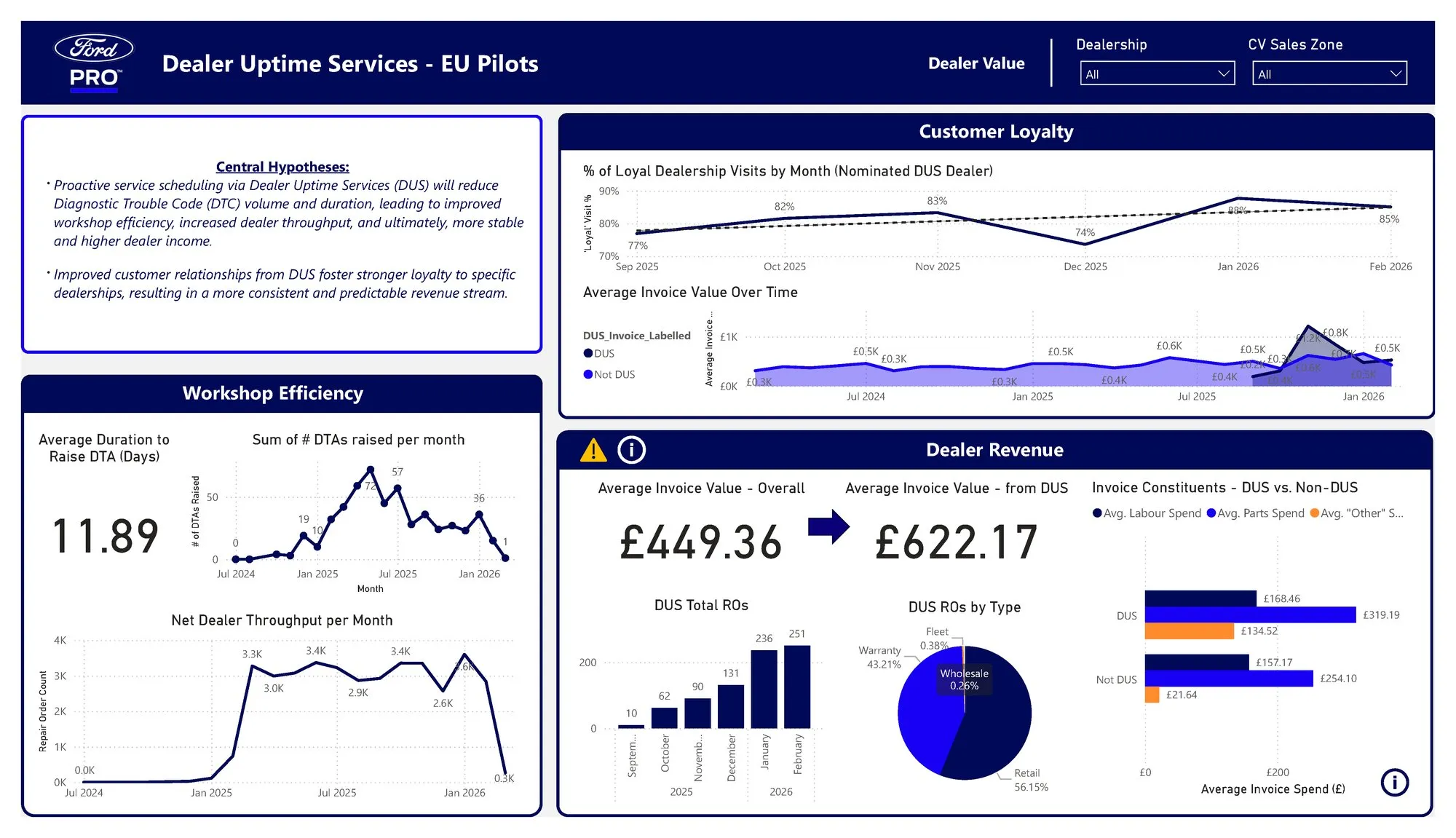
- Invoices: value, type, nominated dealer
- Workshop system: repair order duration
Risks
- Systems aren't integrated, so data gets duplicated or goes missing
07Feedback and research
Physical evidence
Survey, interview invitation
Customer
- Completes the survey
- Takes part in an interview every three months
Dealer front stage
- Follows up and prompts the survey
Dealer back stage
- Takes part in a dealer interview
Ford Pro teams
- CX team designs the survey with dealers
- Research team schedules and runs interviews, then synthesises findings
Systems
Survey platform, video calls
Data I reported from
- Service surveys: NPS, satisfaction, fixed first time
Risks
- Customers already get too many surveys
08Offboarding
Physical evidence
Confirmation that data sharing has stopped
Customer
- Asks to remove vans or cancel
Dealer front stage
- Passes the request to Ford support
- Tells the customer they've been removed
Dealer back stage
- Pays the monthly licence, or stops
Ford Pro teams
- Support raises a task to remove consent
- Pilot team tells dealers when the pilot ends and what happens next
Systems
CRM, marketplace
Data I reported from
- CRM: defleet cases
Risks
- Manual steps won't scale
- No exit criteria or post-pilot plan
See the full map
Every lane, every stage. Scroll sideways.
- Discusses a purchase, renewal or fleet change with the dealer
- Agrees to enrol and picks which vans
- Gets a verification email and sets a password
- Logs in
- Hears from the dealer that the vans are being monitored
- Agrees a time, brings the van in and collects it
- Completes the survey
- Takes part in an interview every three months
- Asks to remove vans or cancel
- Gets trained in person
- Agrees a go-to-market plan with the field team
- Demos the service and the cost and uptime savings
- Prepares consent naming the vans
- Reminds the customer to set a password if they haven't
- Tells the customer they're set up
- Calls the customer to explain the work needed and book it
- Carries out the work and calls when it's complete
- Follows up and prompts the survey
- Passes the request to Ford support
- Tells the customer they've been removed
- Defines its sales pitch for the service
- Shares the van list and consent with Ford
- Reviews alerts daily, grouped by customer
- Checks history and whether the van has been seen elsewhere
- Logs the next action and assigns a caller
- Checks parts lead times and orders
- Schedules the job
- Takes part in a dealer interview
- Pays the monthly licence, or stops
- Account team provisions the dealer, adds the licence and confirms portal access
- Billing sets up the monthly subscription
- Enablement team runs the capability check on each van
- Account team checks for an existing account or creates one
- Sends the verification email
- Enablement team confirms ownership, enrols the vans and records consent
- Chases failures, escalating after two attempts
- Tracks onboarding cases and portal usage
- CX team designs the survey with dealers
- Research team schedules and runs interviews, then synthesises findings
- Support raises a task to remove consent
- Pilot team tells dealers when the pilot ends and what happens next
- CRM: dealer licence start dates
- Training survey: confidence before and after
- CRM onboarding cases: vans submitted vs capable
- Marketplace: customers and accounts
- Marketplace: subscriptions, enrolment status, consent
- Portal analytics: active users, sessions
- Alert back end: severity, time to clear
- Invoices: value, type, nominated dealer
- Workshop system: repair order duration
- Service surveys: NPS, satisfaction, fixed first time
- CRM: defleet cases
- Dealers expect a different tool from the one they'll use
- Ongoing training and support not yet planned
- Sales could take hours or days, which makes set-up hard to plan
- A dealer-led pitch varies from dealer to dealer
- No guaranteed turnaround from the enablement team
- No follow-up if the customer ignores the email
- Unclear delay between consent and data appearing in the portal
- Without tracking, nobody can see where customers drop off
- Systems aren't integrated, so data gets duplicated or goes missing
- Customers already get too many surveys
- Manual steps won't scale
- No exit criteria or post-pilot plan
How the maps were built
The current-state journeys came from dealer site visits and customer panels in the UK and Germany. The pilot journey and blueprint were created in April 2025 and validated in workshops with go-to-market, product and the pilot team before launch in July 2025. Physical evidence, systems and risks sit in the blueprint so operational gaps were visible before the first customer signed up.
Twelve moments to pitch
Dealers are used to closing a sale, not explaining a service. So rather than one sales script, I wrote pitch guidance around twelve natural moments across sales and servicing where dealers could raise uptime, each with an angle that fitted the conversation already happening.
Promotion on the dealer website, with the customer leading the conversation
Answer the needs they raise and show proactive problem-solving and value for money.
Sales exec or call centre
Sales exec gets in touch about replacing a van
How the service simplifies fleet management and lowers running costs over the van's life.
Sales exec or call centre
First consultation in the dealership
Peace of mind. Not every business needs full fleet management, but even the smallest needs uptime.
Sales exec
Add-on while configuring the spec
An investment that protects the van with connected data and makes maintenance costs predictable.
Sales exec
At marketing-consent capture, if the service is free
Easy enrolment and immediate benefits, framed as a complimentary bonus.
Sales exec
Before handover, with the fleet decision-maker
Pick up the earlier conversation, tailor one benefit and offer a no-commitment trial.
Sales exec
At referral to Ford Pro's connected software
How uptime monitoring complements the rest of Ford Pro's connected services.
Sales exec or call centre
Decision-maker consulted about extra work
Cost avoidance and preventative maintenance, plus data sharing if the van's modem isn't active.
Service advisor
Reminder call before an appointment
Convenience, and a service that books itself around the customer.
Call centre or service advisor
After the first health check finds extra work
How monitoring could have caught this earlier, and saved the cost.
Service advisor
Handing the van back after a service
The service is already working behind the scenes. Would they like to know more?
Service advisor
Follow-up once they've had time to think
Answer remaining concerns and reinforce long-term savings and productivity.
Call centre
Not everyone needs a full fleet management solution, but even the smallest businesses need uptime.
What the first pilot dealer taught us
The first pilot dealer was onboarded onto a prototype of Ford’s Vehicle Care Portal, which listed customers’ vans with their health alerts in priority order.
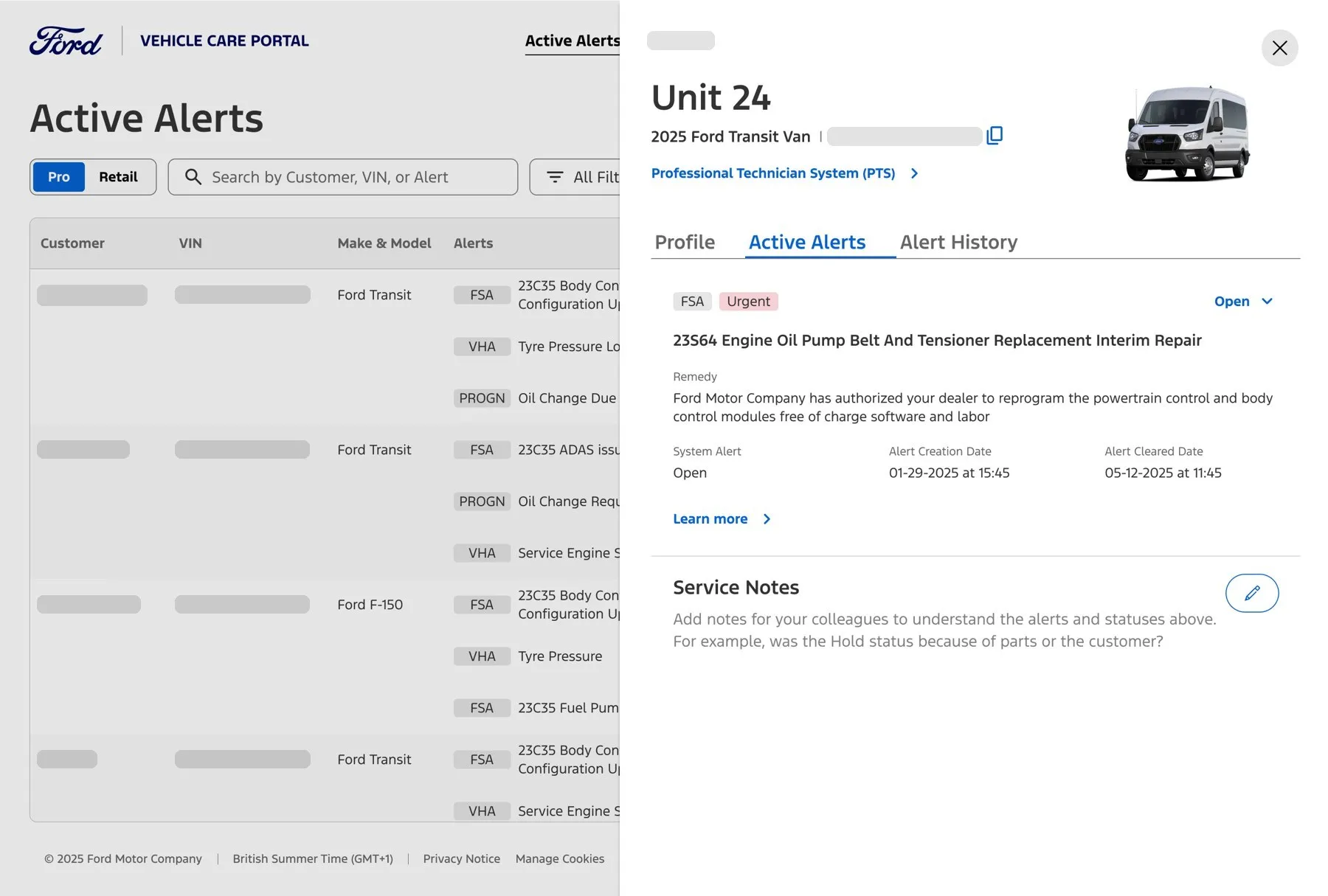
I interviewed pilot dealers during site visits. At this early stage, the first dealer to go live gave us the earliest read on whether the service worked in a real workshop. The interviews uncovered six insights, which shaped dealer roles, training and the pitch:
Usable on day one
Minimal training needed. Non-technical aftersales staff were calling customers and making bookings straight away, so the tool belongs in aftersales, and possibly a call centre in future.
Zero objections to data sharing
Every customer saw the value once it was explained. Consent wasn't the barrier we'd feared, so the pitch could focus on value.
Bookings in the first week
New service bookings arrived within the first week. Whether they were new business or just earlier business was still an open question.
Productivity, not cost
Customers saw the productivity benefit straight away but didn't see uptime as a way to save money, which changes how the pitch should lead.
Not every alert deserves a call
Recall calls were "more useful than the letters", but a low washer fluid call felt "patronising". Which alerts trigger a call matters for the relationship.
Train on demand
Dealers asked for on-demand video training built on case studies and role-play, not just one in-person session.
Designing the measurement framework
The pilot had a central hypothesis but no agreed way of proving it. I turned it into four performance pillars, each with its own hypothesis, so the pilot could answer two questions at once: is the service being delivered the way we designed it, and is it working for dealers and customers? Every metric had a written definition and a named source, collected in a metric dictionary of more than 30 entries inside the dashboard.
Four pillars, four hypotheses
The first two test fidelity: is the service happening? The last two test value: is it worth it?
Hypothesis
Successful dealer training and onboarding is what lets the service gain traction: confident staff onboard customers and secure consent, which drives conversions, enrolments and use of the portal.
What I measured
Hypothesis
If dealers actively use the portal, booking lead times fall and customer satisfaction rises, while throughput and workshop efficiency go up.
What I measured
Hypothesis
Proactive scheduling should mean fewer and shorter fault-driven repairs, more efficient workshops and steadier income, and closer relationships should build loyalty to the nominated dealer.
What I measured
Hypothesis
The service should raise satisfaction by cutting downtime and running costs, with proactive follow-ups and more fixed-first-time repairs building loyalty.
What I measured
Building the pipeline and dashboard
The data to answer those questions sat in ten places owned by different teams, and pilot reporting ran on a weekly manual spreadsheet. I replaced it with an automated pipeline: SQL in Google Cloud joining every source on the van, the customer and their nominated dealer, feeding a single Power BI app, where I used Python to shape and transform the data for the dashboard views.
From ten sources to one app
Two tools, because programme leads and the onboarding team needed different things.
10 sources
Owned by different teams
- Dealer licencesCRM
- Onboarding and defleet casesCRM
- Subscriptions and consentMarketplace
- Enrolment statusMarketplace
- Service surveysMedallia
- InvoicesAftersales data
- Portal engagementAmplitude
- Health alertsPortal back end
- Workshop productivityRepair order data
- Training surveyQualtrics, manual
One reporting dataset
SQL in Google Cloud (BigQuery)
- Joined on van, customer and nominated dealerFull outer joins, because not every van has both a subscription and a consent record
- A DUS repair = after enrolment, at the nominated dealerThe same rule splits DUS from non-DUS survey responses
- Dealer code mappingMatches the several codes one site can have
- Mostly automatic refreshReplaced a weekly manual spreadsheet
One Power BI app
Two tools for two jobs
- Pilot dashboardStrategic. Weekly refresh, by dealer, open to all of Ford. Six pages.
- Onboarding trackerOperational triage. Daily refresh, by dealer and customer, restricted access.
How far the pilot got
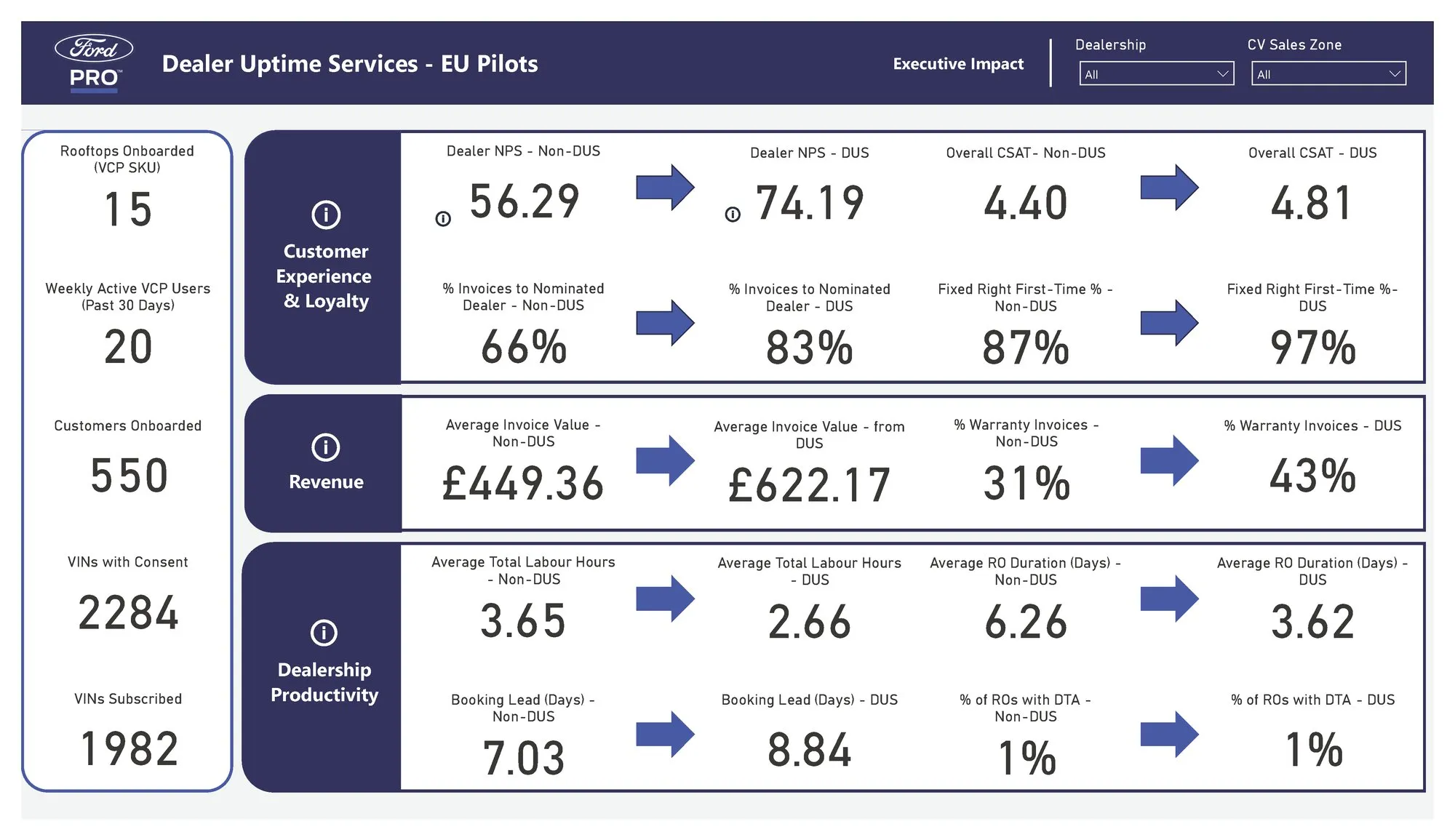
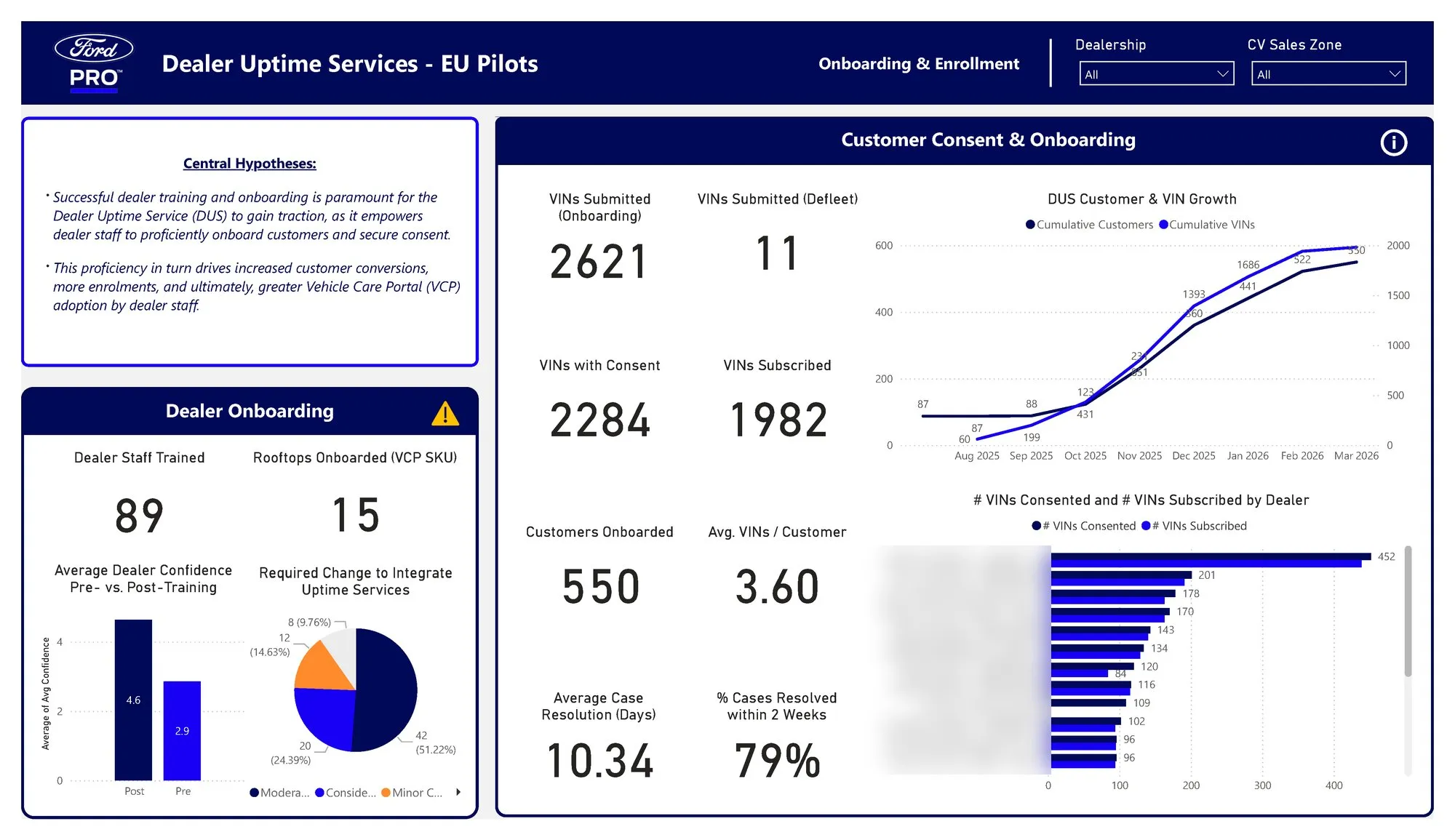
By March 2026, eight months after the first dealer went live, the pilot had grown from 87 customers to 550, and dealers were clearing more than a thousand alerts a month. Compared with the non-DUS baseline, the early signs were good, but not everywhere.
What changed, and what it achieved
Each card starts from a pain point in today's journeys, shows what the pilot changed, and ends with what the dashboard showed by March 2026.
Today
Dealer staff can't answer questions about Ford Pro and lack confidence demoing it
Pilot design
In-person training on the portal and the go-to-market plan, plus pitch guidance for 12 moments
Measured
2.9 → 4.6
dealer confidence before vs after training, with 89 staff trained
Today
Dealers can only refer customers to Ford Pro, with no visibility of what happens next
Pilot design
The dealer owns the sale: prepares the contract and consent, and is told when the vans are live
Measured
550
customers onboarded, with 79% of onboarding cases resolved within 2 weeks
Today
Drivers ignore warning lights and don't tell the fleet manager
Pilot design
The dealer reviews prioritised health alerts daily and calls the customer first
Measured
87%
of alerts cleared within 7 days, and over 1,000 resolved a month at peak
Today
Not knowing when the van will be back is worse than the breakdown itself
Pilot design
Parts pre-ordered, a time agreed, cost known up front, and a call when it's ready
Measured
6.26 → 3.62
days average repair order duration, DUS vs non-DUS
Today
Customers get passed between Ford and dealer contacts, and vans end up at other sites
Pilot design
One nominated dealer as the customer's single point of contact for uptime
Measured
66% → 83%
of invoices at the nominated dealer
Today
Customers can't easily get to the dealer during opening hours
Pilot design
Proactive booking at a time agreed with the customer
Measured
7.03 → 8.84
days booking lead time. It got worse, and was still an open question
Alerts resolved per month
Health alerts dealers actioned in the portal
| Sep | Oct | Nov | Dec | Jan | Feb |
|---|---|---|---|---|---|
| 58 | 236 | 498 | 788 | 1,133 | 991 |
DUS repair orders per month
Repairs at the nominated dealer after enrolment
| Sep | Oct | Nov | Dec | Jan | Feb |
|---|---|---|---|---|---|
| 10 | 62 | 90 | 131 | 236 | 251 |
Visits to the nominated dealer
Share of service visits (%)
| Sep | Oct | Nov | Dec | Jan | Feb |
|---|---|---|---|---|---|
| 77% | 82% | 83% | 74% | 88% | 85% |
All DUS vs non-DUS comparisons
Customer experience and loyalty
Dealer NPS
Overall satisfaction (out of 5)
Invoices at the nominated dealer
Fixed right first time
Revenue
Average invoice value
Warranty share of invoices
Dealer productivity
Repair order duration (days)
Labour hours per job
Booking lead time (days)
Repair orders needing technical assistance
What these numbers can and can't tell you
- Small survey sample. Only 31 survey responses came from DUS customers, against 2,931 non-DUS responses over two years. The NPS gap is a promising signal, not proof.
- Correlation, not causation. Alert logs didn’t carry van IDs, so a specific alert couldn’t be linked to a specific repair. High portal use and high throughput moved together; we couldn’t prove one caused the other.
- Inferred DUS repairs. A DUS customer serviced at a different Ford dealer counts as non-DUS, so retention is probably under-reported.
- Loyalty isn’t benchmarkable yet. DUS loyalty is measured from enrolment; Ford’s standard loyalty metric uses 12 months, so the comparison is against each dealer’s own baseline.
- Booking lead time got worse. Proactive bookings may simply be made further ahead, but that was still to be tested.
Handing it over
Before I left, I made sure the pilot wouldn’t lose its reporting with me. I wrote a developer guide covering every source, owner, refresh step, environment and query, and documented the data’s limits alongside a fix for each.
I also assessed what it would take to scale the reporting to five European markets, and was direct about the biggest risk: me. The pilot’s reporting depended on one person, so I recommended:
A dedicated analytics owner
To triage data breaks, handle requests across markets and tune the SQL as volumes grow 5 to 10 times.
A staging layer
Clean and index data in Google Cloud before Power BI, so expensive joins don't time out at EU scale.
One source of truth
Agree the dashboard as the only reporting tool for the rollout, with a formal RACI, to avoid shadow reporting.
The dashboards became the central reporting tool as the pilot scaled, and then for the market launch of Dealer Uptime Services.
What I learned
About services
- A service is only as good as its back stage. Most risks on the blueprint were handoffs between teams, not the customer-facing moments.
- Dealers needed help selling, not just help using the tool.
- Real dealers beat assumptions: data sharing wasn't the barrier, and the wrong alert can damage a relationship.
About measurement
- Decide what counts before you build anything. The DUS repair definition did more work than any chart.
- Put the caveats next to the numbers, so a promising signal isn't read as proof.
- If reporting depends on one person, say so, and plan the handover early.